skip to main |
skip to sidebar
[To read Part One of this essay, click here.]
Dinner At Eight: Harlow Arrives At Last
 "I was reading a book the other day."
"Reading a book?!?"
"Yes. It's all about civilization or something. A nutty kind of a book. Do you know that the guy says that machinery is going to take the place of every profession?"
"Oh, my dear, that's something you need never worry about."
 After a second movie with Gable, Hold Your Man (actually their third—Gable and Harlow had small roles in the 1931 gangster movie The Secret Six, but weren't paired together), Harlow gave what may be her best-remembered performance, that of none-too-bright social climber Kitty Packard in the comedy-drama, Dinner At Eight.
A successful play by Broadway legends George S. Kaufman and Edna Ferber, Dinner At Eight is a loosely-connected series of vignettes about a group of Manhattan social climbers preparing for a dinner party as their respective worlds fall down around their ears. Seeing Dinner At Eight as a potential follow-up to 1932's Grand Hotel, a star-studded extravaganza that had won the Academy Award for best picture, MGM producer Irving Thalberg bought the film rights to the play, but fell ill soon after and took a leave of absence from the studio. Louis B. Mayer, long jealous of Thalberg, sensed an opportunity to increase his control of MGM and brought in his son-in-law, David O. Selznick, who reluctantly left his post as head of RKO Studios to head up the production (prompting wags to quip "the son-in-law also rises").
 For Dinner At Eight, Selznick assembled the brightest of MGM's stars, including the three male leads from Grand Hotel, and added America's most popular actress Marie Dressler as a faded Broadway star, Billie Burke as the twittery hostess of this train wreck, and finally Harlow as the spoiled young trophy wife of Wallace Beery's crooked businessman. (Joan Crawford turned down the part of a woman cheating on her fiance, the most thankless role in the movie; it went to Madge Evans instead.)
 Director George Cukor, fresh off Katharine Hepburn's successful debut in A Bill Of Divorcement, cast Harlow over the objections of Louis B. Mayer, who felt she wasn't actress enough to keep up with her more experienced co-stars. But Red Dust had convinced Cukor that Harlow had a gift for comedy and with the director's help, she wound up stealing the show.
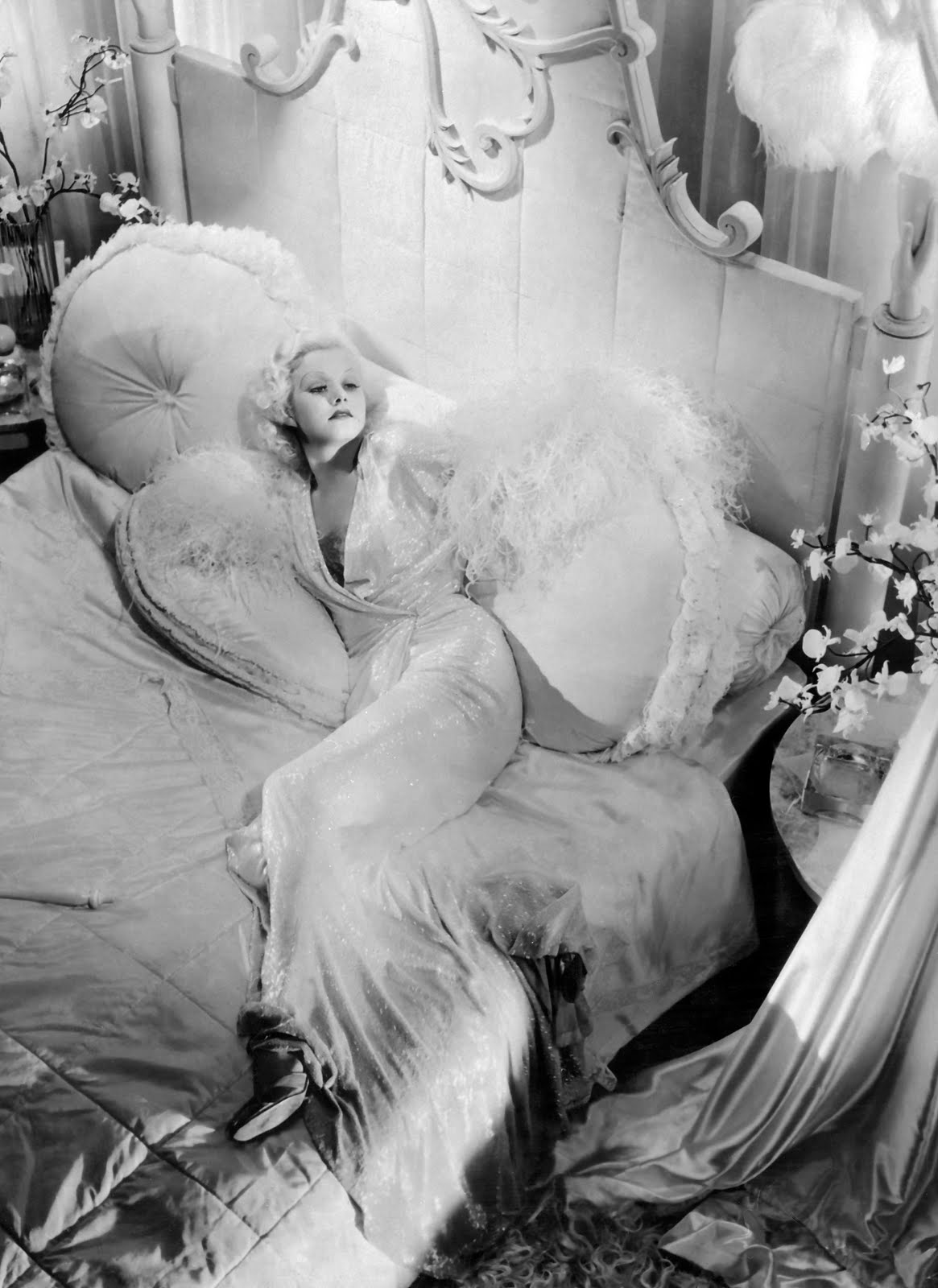
Outside of Karl Marx, Dinner At Eight is as scathing an indictment of the monied classes as you're likely to find, and no character is more indolent than Harlow's Kitty. She manipulates her men, bullies her maid, and otherwise lies around in a torpor, eating bonbons and complaining of boredom. "She holds court from her bed," Matthew Kennedy wrote for Bright Lights Film Journal, "like a spoiled Persian cat, a disagreeable chocolate substituting for a furball."
 And yet because she hungers to improve herself (even if she seems to think the surest path to knowledge is to sleep with an educated man), we find ourselves rooting for Kitty. "I'm going to be a lady if it kills me," she vows.
Ironically, the woman Kitty most aspires to be—Billie Burke's Millicent Jordan—is even more empty-headed than she is, and without a backless evening gown to take your mind off the fact.
In terms of its complexity, the role of Kitty Packard was a leap for Harlow, but where she had been ill-equipped to handle early roles in Hell's Angels and Platinum Blonde, now she was ready. In Red-Headed Woman, she'd learned how to gain an audience's sympathy despite playing an unlikeable character. In Red Dust, she'd learned how to deliver dialogue (tough wisecracks, for example) while conveying a deeper truth (hurt, vulnerability) with her eyes.
In Dinner At Eight, she found the last piece of the puzzle, "the ability," in the words of Frank Miller, writing for Turner Classic Movies, "to deliver lines as though she didn't quite know what they meant."
The result was the best performance of her career.
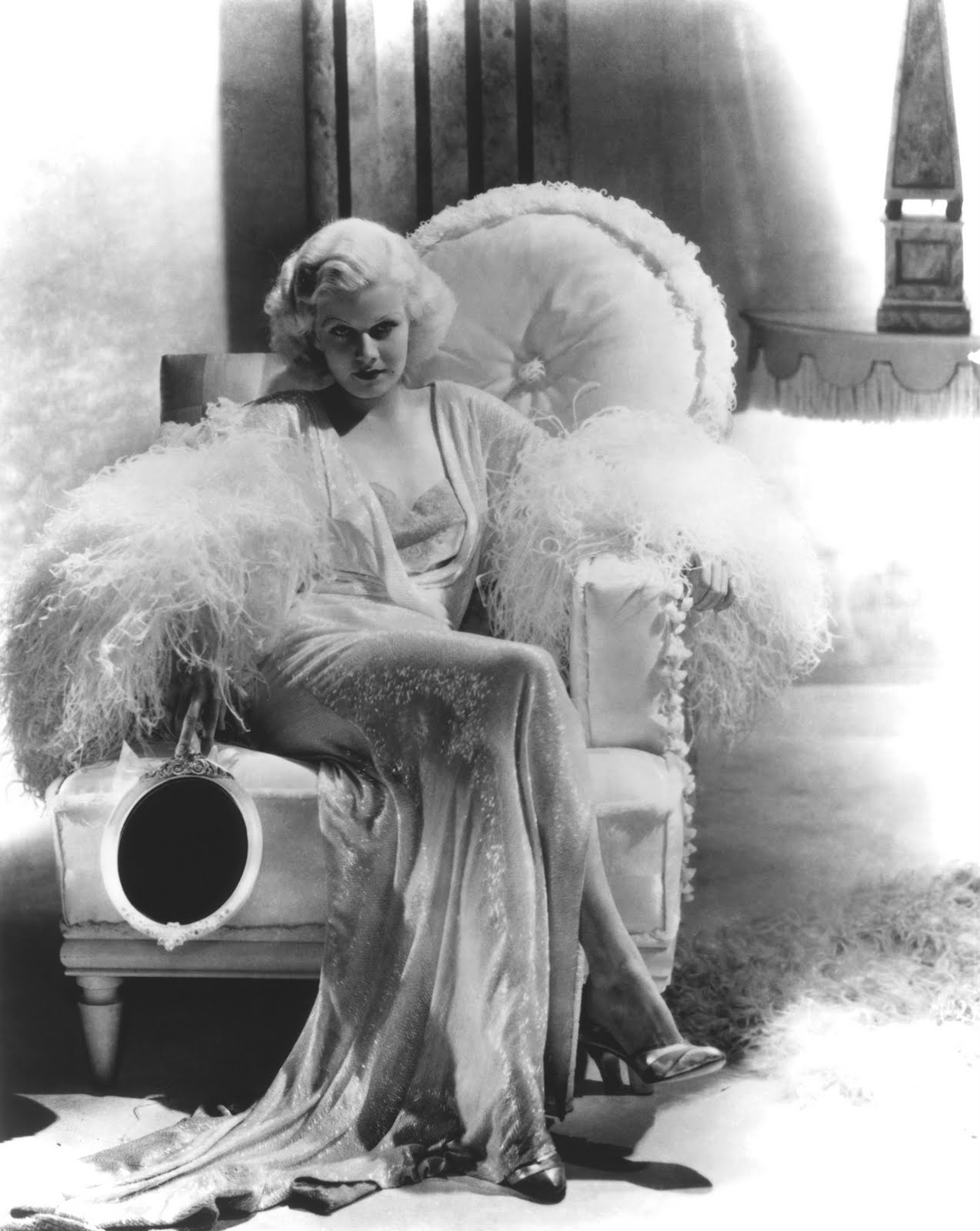
 "Harlow played comedy," said Cukor, "as naturally as a hen lays an egg."
The most famous scene in Dinner At Eight is the last one between Harlow and Marie Dressler—and justly so, with Dressler's famous doubletake and last line—but it's not really Harlow's scene, except to serve up a couple of terrific straight-lines. Instead check out her scenes with Wallace Beery, who plays her boorish husband. The two bicker and battle, the collision of small minds and titanic wills, and despite Beery's expertise at hammy scene stealing, it's Harlow the viewer remembers.
Their verbal sparring ("Remember what I told you last week?" "I don't remember what you told me a minute ago.") escalates to point of physical violence, with Harlow delivering a pivotal ultimatum in one breathless rant:
 "Who do you think you're talking to, that first wife of yours out in Montana? That poor mealy-faced thing with a flat chest that didn't have nerve enough to talk up to you, washing out your greasy overalls and cooking and slaving in some lousy mining shack—no wonder she died. Well, you can't get me that way, you're not going to step on my face to get where you want to go, you big windbag! ... Politics? Ha! You couldn't get into politics. You couldn't get in anywhere. You couldn't even get in the men's room at the Astor!"
It's a tour de force moment both for Harlow and for the film, and it contrasts nicely with Kitty's previous lethargy and coy manipulations. The antipathy between Beery and Harlow was genuine, but they were a great screen couple and they made one more movie together, China Seas in 1935.
 Movie-going audiences loved Dinner At Eight and loved Harlow in it, not only because she looked great in her backless evening gown (designed by Adrian, it was known as the "Jean Harlow dress" and was so tight she couldn't sit down in it), but also because she had proven herself once and for all as one of Hollywood's great comedic actresses.
"Acting honors," said Variety at the time, "probably will go to Dressler and Harlow, the latter giving an astonishingly well-balanced treatment of Kitty, the canny little hussy who hooks a hard-bitten and unscrupulous millionaire and then makes him lay down and roll over."
According to KC at Classic Movies, Dressler was so impressed with Harlow that she hoped she and Harlow could work together again, starting "an entirely new kind of comedy team—the glamour girl and the matron." Dressler, however, died of cancer just a year later and the two never made another movie together.
As it was, when Harlow finished her last scene for the movie, she went to her dressing room and cried, perhaps knowing nothing she ever did afterwards would top this performance.
 As a postscript, I should mention that Harlow's real-life dinner at eight didn't go nearly so well as the onscreen one. At a party for the British prime minister, Harlow found herself seated next to the PM's wife, Margot Asquith, Countess of Oxford and Asquith. Throughout the dinner, Harlow addressed her as "Margot," pronouncing the "t," until finally the Countess said, "No, no, the 't' is silent, as in 'Harlow.'"
Apocryphal, perhaps, but a good punchline.
Note: To read my essay on John Barrymore's performance in Dinner At Eight, click here.
[To read Part Three of this essay, click here.]
 Many actors have laid claim to the title of the Biggest Ham in Hollywood over the years—Wallace Beery, Christopher Walken, William Shatner, Jack Nicholson, even Laurence Olivier when he was bored and phoning it in—but few at their peak were as deliciously hammy as John Barrymore.
Bad ham acting takes no especial skill other than a lack of talent and self-awareness, and bad ham actors, whose numbers would fill a football stadium, take you right out of the action, start you looking for the exits and are either quickly forgotten or wind up making miniseries on the Lifetime Channel. "[A] bad ham actor," writes "Greg" at Cinema Styles, "is a bad actor period, someone who overplays, overemotes and overinflects every move, tear and shout. They're bad, they don't know how to do anything else.
"But a great ham actor is also a great actor who is in possession of so much skill and talent they know when to go over the top and how far to take it."
Great ham acting is an underappreciated art form and great ham actors, so few we can nearly name them all, last for years, energize the mundane, create a giddy sense of the possible. And with Dinner At Eight, John Barrymore put the capstone on a career that featured some of the best ham acting in the history of Hollywood. His Larry Renault—like Barrymore, an alcoholic ham on the downside of his career—was, as TV Guide put it in its 5-star review, "a bitchy casting idea, chilling to watch," but Barrymore was open to taking himself to task on screen, and though it was all downhill after this, he played the part to perfection.
 The action opens as Park Avenue socialite Millicent Jordan (Billie Burke, in a performance that would establish her chirpy screen persona) frantically puts the finishing touches on an important dinner party she's planned for that evening. Absorbed with trivial worries about aspic and ice sculptures, she's oblivious to the crises mounting around her—her ailing husband (Lionel Barrymore) finds himself on the verge of losing everything to a rapacious tycoon (a particularly boorish Wallace Beery), her daughter is about to marry a man she no longer loves, and old friend Carlotta Vance (Marie Dressler), an over-the-hill actress, needs money fast.
Add to the list of the desperate a last-minute substitution on the guest list, Larry Renault (John Barrymore), a one-time silent film star now fallen on hard times thanks to his outsized ego and fondness for the bottle. Reduced to pawning his cufflinks for cabfare, he's in New York hoping to make a comeback on the Broadway stage. "The play's not much," he says, "but I think I can put it over. I play the only male character," then shrugs, "oh, there's a small male part for a bit actor ... but I dominate that."
Perhaps you can guess how this is going to turn out for him, even if he can't.
 Dinner At Eight is usually billed as a comedy, and it is, but only in the same sense that Anton Chekhov's masterpiece of endless Russian gloom, The Cherry Orchard, is a comedy. That is, it's a tragedy about foolish people in relentless pursuit of the ephemeral, behaving as if they'll live forever and discovering too late that they won't. You see this same comedy played out, in high places and in low, every day, and always with the same ending.
The cast of characters neatly divides into those who, either through careless living or bad luck, find themselves at the end of their ropes; and those who prey upon them, both wittingly (Beery) and unwittingly (Burke). (That Jean Harlow, playing a low-rent Billie Burke in training, proves to be an angel of mercy for one of these desperate souls gives us the only hopeful moment in the entire movie.)
In the self-contained universe of the New York blue bloods who populate Dinner At Eight, it perhaps shouldn't come as a surprise that Renault is sleeping with Mrs. Jordan's nineteen year old daughter Paula (Madge Evans in a part originally offered to Joan Crawford). For her, Renault represents a chance to escape the spiritually-empty and empty-headed future her mother has so carefully planned for her; but for him, Paula is a last taste of the life he has wasted and she's too young to understand why he feels only anxiety when what she feels is bliss.
"You're young and fresh," he tells her, "and I'm burned out."
 For Renault, it's an all-too-infrequent moment of clarity that lends poignancy to his plight—it's one thing to spiral into the abyss in ignorance, quite another to watch yourself do it—and Barrymore is at his best in these moments, quiet, still, a great actor inhabiting a burned-out shell without resorting to showy actor tricks. Then as Renault puffs himself up with self-pity, paranoia and memories of past glory, Barrymore reaches for just those hammy touches that a bad actor would use on a stage when playing a part too big for his talent.
Ultimately, the moral of Dinner At Eight is "adapt or die," a timely message in 1933 for both out-of-work actors and a nation suffering through the fourth year of the Great Depression, but advice Renault is incapable of following. He may be a high-functioning alcoholic, immaculately dressed and able dip into his bag of acting tricks just enough to fuddle his way through a speech or two—watch Barrymore dial up the ham factor as he demonstrates Renault's "acting" ability—but he can't keep his delusions of grandeur in check and, like a man on a ledge with an uncontrollable urge to jump, each moment of clarity turns into self-pity and another excuse to take a drink.
 Whether the bottle has kept him from acclimating or he turned to the bottle because he couldn't (it doesn't really matter; an alcoholic doesn't need a reason to drink), Renault is a man frozen in time. He still fancies himself an "important artist," a matinee idol, a big name. "$8000 a week is what I got," he says, "and I was gonna get ten until the talkies came in, so don't think you're doing me a favor by asking me to play in your ratty little show because I'm doing you one." But the sad fact is, he's a forgotten has-been and when he finally grasps the truth, it's brutal to watch.
"Look at those pouches under your eyes," says his long-suffering agent, steering Renault to the mirror. "Look at those creases. You sag like an old woman. ... You're a corpse, and you don't know it. Go get yourself buried."
 Barrymore's Renault is by turns buffoonish, arrogant, reflective, bullying, anxious, humiliated, and ultimately, by remaining true to his idea of himself to the very end, somehow heroic. In a contemporaneous review of Dinner At Eight, Variety heralded Barrymore's performance as "a stark, uncompromising treatment of a pretty thorough-going blackguard and ingrate."
Recent reviews have echoed the sentiment: "John Barrymore is beautiful as the only honest man in the entire picture." (Movie Reviews UK) Renault is "played with the right touch of self-centered clownishness to undercut the pathos." (Slant Magazine) Barrymore's Renault, "the Profile in winter [is a] small, honest portrait of reaching the end of your tether." (Bright Lights Film Journal)
 And me? I think it's possibly the best portrayal of an alcoholic in the movies before Ray Milland's Oscar-winning turn in The Lost Weekend twelve years later, certainly one of the few serious ones at a time when alcoholics in movies were almost always treated as comic relief. And as a portrait of a man at the end of his rope, Barrymore's performance would make a terrific double feature with his work from the year before in another glamorous MGM ensemble piece, Grand Hotel.
Director George Cukor later said of Barrymore that he had no vanity and noted that many of the ideas for Renault's character came from Barrymore himself:
"[Renault] found out that another actor got the job that he desperately needed," Cukor recalled, "And he'd say, 'I can be English. I can be as English as ahnybohdy.' Then he'd say, 'Ibsen, Ibsen. I can do Ibsen,' and he had just heard vaguely of Ibsen, and he would strike this absolutely inappropriate pose and he said, 'Mother dear, give me the moon.' Whereas the Ibsen line was, 'Mother, give me the sun'—to show that he'd gone over, he'd become mad.'"
Yet as good as Barrymore's performance was, it almost didn't happen.
 According to Frank Miller, writing for Turner Classic Movies, MGM Studio chief Louis B. Mayer objected to the casting of Barrymore. "He was worried about Barrymore's drinking and erratic behavior," Miller writes, "but Cukor assured him that they had developed a good working relationship on A Bill of Divorcement (1932). On the set of Dinner at Eight Barrymore was cooperative and helpful. Far from resisting comparisons between himself and his character, a fading matinee idol succumbing to alcoholism, he suggested playing up the similarities. At his instigation, [Frances] Marion and co-writer Herman J. Mankiewicz added references to his profile and his three wives. On the set, he even improvised imitations of faded actors he'd run into in New York."
Born John Sidney Blyth in Philadelphia in 1882, John Barrymore was the youngest sibling of an acting dynasty that included Oscar-winners Lionel and Ethel (they took their stage name from their father, who performed as Maurice Barrymore). While Lionel and Ethel took to the stage at an early age, John began as a painter, and only followed his siblings into acting at their urging. Despite his late start, he was a major Broadway star by 1909. His Broadway performance in the title role of Hamlet in 1922 purports to be one of the best in history although no recording of it exists and recreations nearly two decades on are marred by Barrymore's shameless mugging.
 Although he may have appeared in films as early as 1912, his first confirmed role was in An American Citizen in 1914. Known as "The Great Profile," Barrymore was a star throughout the silent era, appearing in such films as Dr. Jekyll and Mr. Hyde (1920), Sherlock Holmes (1922), Beau Brummel (1924) and Don Juan (1926).
Barrymore made the transition to talkies successfully, and I'm not convinced playwrights George Kaufman and Edna Ferber (Marion and Mankiewicz handled the screenplay chores) had Barrymore in mind when they wrote the part—he was still a star even if his drinking and ego were already the stuff of legend, and the story of the silent era matinee idol reduced to penury with the coming of the talkies was so commonplace as to be a cliche. Still, I couldn't help wondering as he studied his aging, alcohol-ravaged face in that last, painful scene, whether Barrymore saw his own future writ large in the mirror.
 Aside from his terrible thirst, I get the impression Barrymore's biggest problem was not so much an oversized ego, as a lack of regard for the art of motion pictures—much like Marlon Brando after him, he rarely thought of the movies he made as worth the effort. "Watching Barrymore on screen," Dan Callahan wrote, "we are always waiting to see whether he will engage with his material; if he does, he's capable of large-spirited magic, and if he doesn't, he merely moves his face and pops his eyes, wearily, as if he's trying to be amused."
"My memory is full of beauty," Barrymore once quipped, explaining why he hadn't bothered to learn his lines before filming a scene, "Hamlet's soliloquies, the Queen Mab speech, King Magnus' monologue from The Apple Cart, most of the Sonnets. Do you expect me to clutter up all that with this horseshit?"
 For a while at least, until the effects of indolence and alcohol caught up with him, Barrymore could still reach down for worthy films such as Grand Hotel, A Bill Of Divorcement, Counsellor-at-Law and Dinner at Eight and produced a good performance. The rest of the time, though, he was content to give the people what they wanted, a parody of himself.
"I like to be introduced as America's foremost actor. It saves the necessity of further effort."
John Barrymore died in 1942 of pneumonia as a complication of cirrhosis of the liver. He was sixty years old.
[To read my take on Jean Harlow's performance in Dinner At Eight, click here.]
 Here's another award that tied me in knots for a while and with good reason. The five nominees belong on a short list of the greatest character actresses of the era, each appearing in superb movies while giving performances that are both memorable and representative of their careers as a whole.
Elsa Lanchester gave the first great performance of her long career as a decidedly non-historical Anne of Cleves in the witty satire The Private Life Of Henry VIII. Conversely, Marie Dressler, beloved in her day, largely forgotten now, gave the last great performance of her career, playing a has-been actress and veteran flirt too old to any longer trade on her name or looks in Dinner At Eight. And Billie Burke and Una O'Connor provide wonderful comic relief to what at times are quite serious movies, the former as a ditzy socialite in the aforementioned Dinner At Eight, the latter as a terrified scullery maid in The Invisible Man.
Any one of them would have been a good choice. A couple of them were almost mine.
But simply put, Margaret Dumont was the most talented straight-(wo)man in the history of movie comedies, and Duck Soup being both the best movie of the year and the most representative of her gifts, she's my pick as the best supporting actress of 1932-33.
 Born Daisy Juliette Baker in Brooklyn in 1882 (she claimed to have been born Marguerite Baker in Atlanta in 1889), Margaret Dumont was raised by her godfather Joel Chandler Harris, author of the Uncle Remus stories. Dumont trained as an opera singer and spent the first decade of the twentieth century working as a singer and comedic actress, both abroad and on the American vaudeville circuit. Described in reviews of the time as "a statuesque beauty," Dumont met and married the wealthy industrialist John Moller, Jr. in 1910 and retired from the stage, but returned eight years later after his sudden death.
It was playwright George S. Kaufman who recommended Dumont for the role of a stuffy dowager staying at a hotel run by the Marx Brothers in the Broadway stageplay, The Cocoanuts, and she proved so successful as a comic foil to the supremely irreverent Groucho, she was cast in a nearly identical part in the Brothers' next play, Animal Crackers, then reprised both roles for film.
"There has never been a good comedian that didn't have a good straight man," Groucho said. "Audiences don't think the straight man means anything, but it's very important."
 The role of the stuffy rich widow was a part she played in all seven of the Marx Brothers films she appeared in, and she played the part perfectly—regal and self-possessed without being arrogant, naive and romantic without being vulnerable—so that the audience neither felt sorry for her not angry at her as Groucho bounces insults off her. Indeed, his attempts at seduction play as surreal rather than hostile, enhancing the anarchic quality of the Marx Brothers' humor.
"Not that I care, but where is your husband?"
"Why, he's dead."
"I bet he's just using that as an excuse."
"I was with him to the very end."
"No wonder he passed away."
"I held him in my arms and kissed him."
"Oh, I see, then it was murder! Will you marry me? Did he leave you any money? Answer the second question first."
(In real life, Groucho's aggressive banter drove three wives to drink. Maybe he should have married Margaret Dumont as many fans in the 1930s assumed he had.)
The widely-accepted notion that Dumont had no sense of humor, promoted by Groucho, studio publicists and perhaps by Dumont herself, is belied not only by the evidence of her early career as a comic actress but from her performances in the movies themselves.
 Listen sometime to her delivery of a line like "It's a gala day for you" from Duck Soup (to which Groucho replies, "Well, a gal a day is enough for me. I don't think I could handle any more.") The line comes at the end of a long, florid speech and as she arrives at the straight-line, her pace slows up just a hair and she adds a slight emphasis to the words, setting the gag up on a tee for Groucho. She clearly understood how a gag was constructed and how to deliver a straight-line in a way that made the audience anticipate the punchline, which as Buddy Hackett once explained to Roger Ebert, goes a long way toward selling a joke.
"I'm a straight lady," Dumont once said, "the best in Hollywood. There is an art to playing the straight role. You must build up your man but never top him, never steal the laughs." Groucho recognized as much when upon accepting an honorary Oscar, he spoke of Chico and Harpo then added, "I wish Margaret Dumont could be here, too. She was a great straight-woman for me."
 Dumont also knew how to react to Groucho's gags. It may sound counter- intuitive, but in a comedy it's important that none of the actors in it signal to the audience that they know they're in a comedy. Unless you're Harvey Korman on the old Carol Burnett Show, where half the fun was watching him trying and failing to keep a straight face, a comic actor has to react as though what is happening makes complete sense in the world he inhabits; to laugh at the punchline is to take all the air out of the gag. Dumont's reactions punctuate the humor without puncturing it. Nobody else in the Marxian universe ever did it better.
And then, of course, with her battleship bearing and her battleship body, Dumont not only feeds Groucho an endless series of straight-lines, but is a walking straight-line herself.
"I've sponsored your appointment," she intones, "because I feel you are the most able statesman in all Freedonia!"
"Well, that covers a lot of ground," Groucho says. "Say, you cover a lot of ground yourself. You'd better beat it. I hear they're gonna tear you down and put up an office building where you're standing."
Let's face it—it's funny because it's true. We're just too polite to say so.
 And then Dumont was often given the thankless task of keeping the slender narrative of the Brothers' movies on track. This was especially true in Duck Soup where she insists on the appointment of Rufus T. Firefly (Groucho) as leader of Freedonia; introduces him to his political and romantic rival Trentino of Sylvania (Louis Calhern); worries about the secret code (and two pair of plans!); and tries to prevent war; all without ever becoming tedious in the process.
 The best example of Dumont's work in Duck Soup is the scene in her bedroom involving all three Marx Brothers. Attempting to steal secret war plans hidden in Dumont's safe, Chico and Harpo (disguised as Groucho), followed by Groucho himself, pop in and out of her room with all the freneticism of a British bedroom farce.
"Your Excellency, I thought you'd left!"
"Oh no," says Chico, "I no leave."
"But I saw you with my own eyes!"
"Well, who you gonna believe, me or your own eyes?"
Here, Dumont plays off three different styles of comedy—Groucho's hostile levity, Chico's faux Italian malapropisms and Harpo's pantomime—but just as Ringo mastered every musical style John, Paul and George threw at him without losing the beat (or his temper), Dumont plays off all three of the Brothers expertly.
Eventually you come to realize what you're watching in Dumont and the Marx Brothers is the equivalent of a tight little Jazz band, with Dumont providing a steady backing rhythm that keeps Groucho's (and his brothers') wild improvisations grounded and on track.
It's surprising then that the Marx Brothers ever worked with anyone else, and I suspect some (very) casual fans might not even be aware that she didn't. In fact, though, after the release of Animal Crackers in 1930, the Marx Brothers left New York for Hollywood; Dumont did not follow them. Whether that was her choice or theirs, I don't know, but in any event, the studio opted for the glamorous Thelma Todd in her place. Todd was young, beautiful and a veteran of the Hal Roach Studios where she made comedies with Laurel and Hardy, among others. Yet as lovely as she was, and no doubt comically adept, Todd's presence in Monkey Business and Horse Feathers serves only to underscore what Dumont brought to the proceedings.
 In her two movies with the Marx Brothers, Todd played a seductress who has all four brothers panting for her company. Unfortunately, as it turned out, there's nothing inherently funny about a middle-aged man attempting to seduce a beautiful young woman—embarrassing maybe, and certainly foolish, but funny? Indeed, at times, watching Groucho and his brothers fawning over Todd is a bit creepy (to me, anyway).
Further, what is surreal and subversive when aimed at Dumont becomes hostile and misogynistic when aimed at Todd. Take for example Erik Beck's (of the Boston Becks) favorite line from Duck Soup—"We go forth to fight for this woman's honor, which is probably more than she ever did." Applied to Dumont, the idea is absurd and incongruous and just plain hilarious. Not only does the physically imposing Dumont look like she could snap a man in half (certainly Groucho, who was two inches shorter than Dumont), she also comes across as a woman so Victorian, she doesn't even know what sex is, much less engage in it wantonly—you'd probably just bounce off of her.
 But can you imagine that same line spoken about Thelma Todd, or any other young, beautiful actress? Suddenly it becomes a credible insult and not a funny one at that.
Besides, the Marx Brothers are funniest when they stop making sense altogether and there's nothing nonsensical about Thelma Todd. I mean, who wouldn't want to make love to Thelma Todd? But Margaret Dumont? That's plain crazy.
In her 1937 review of A Day At The Races, film critic Cecilia Ager wrote perhaps the finest tribute ever to Dumont's talents:
"There ought to be a statue erected, or a Congressional Medal awarded, or a national holiday proclaimed, to honor that great woman, Margaret Dumont, the dame who takes the raps from the Marx Bros. For she is of the stuff of which our pioneer women were made, combining in her highly indignant person Duse, stalwart oak, and Chief Fall Guy—a lady of epic ability to take it, a lady whose mighty love for Groucho is a saga of devotion, a lady who asks but little and gets it.
"Disappointment can't down her, nor perfidy shake her faith. Always she comes back for more though slapsticks have crippled her, custard pies spattered her trusting face. Surrounded by brothers who are surely a little odd, she does not think so. To her, her world of Marx Bros. pictures is rational, comprehensible, secure. Calmly she surveys it, with infinite resource she fights to keep on her feet in it. Equally ready for amorous dalliance or hair-pulling, for Groucho's sudden tender moods, or base betrayal, all her magnificent qualities are on display in A Day At the Races, where once again her fortitude is nothing human. It's godlike."
 It's a pity more people didn't recognize Dumont's gifts at the time. Her success with the Marx Brothers led to typecasting and pretty much finished her dreams of taking on dramatic film roles. She appeared in fifty movies in a career that began with an uncredited bit part in 1917's A Tale Of Two Cities and ended shortly before her death in 1965 with a televised performance with Groucho on The Hollywood Palace where she reprised her role as Mrs. Rittenhouse from Animal Crackers.
"Don't step on those few laughs I have up here," he ad-libbed at one point, for once cracking up the consummate straight woman.
Margaret Dumont called herself the best straight woman in Hollywood and when I look back over the history of film comedy, I can't think of a better one. And more to the point, I can't think of a more indispensable one. With all due respect to Zeppo, Margaret Dumont was the real fourth Marx Brother.
Postscript: Half a dozen sources note that Margaret Dumont won the Screen Actors Guild award for best supporting actress of 1937 for her work in A Day At The Races—sources beyond the ever-reliable Wikipedia, such as The Marx Brothers: A Bio-Bibliography by Wes D. Gehring and Hal Erickson's All Movie Guide. Well, maybe. The Screen Actors Guild Awards as we currently know and love them only came into existence in 1995, so perhaps these sources are referring to an earlier, now-defunct version of the award. Or perhaps it was some other award. Only I can't find any reference to any of the other winners of such an award from 1937 and the usually thorough Internet Movie Database doesn't mention it at all. But there are many things I don't know and maybe she did win some kind of an award for A Day At The Races. If so, good for her, because she certainly deserved some recognition in her lifetime.
Can anybody out there clear up the discrepancy? If so, I'd appreciate it if you'd drop a line in the comments box and fill me in.
In any event, she's now won a Katie-Bar-The-Door Award which trumps the Screen Actors Guild any day, and I'm sure if Margaret Dumont were alive today, she'd rise up out of her grave, and we'd only have to bury her again.
Note: To read about Duck Soup's screenplay, click here.


 "I was reading a book the other day."
 After a second movie with Gable, Hold Your Man (actually their third—Gable and Harlow had small roles in the 1931 gangster movie The Secret Six, but weren't paired together), Harlow gave what may be her best-remembered performance, that of none-too-bright social climber Kitty Packard in the comedy-drama, Dinner At Eight.
 For Dinner At Eight, Selznick assembled the brightest of MGM's stars, including the three male leads from Grand Hotel, and added America's most popular actress Marie Dressler as a faded Broadway star, Billie Burke as the twittery hostess of this train wreck, and finally Harlow as the spoiled young trophy wife of Wallace Beery's crooked businessman. (Joan Crawford turned down the part of a woman cheating on her fiance, the most thankless role in the movie; it went to Madge Evans instead.)
 Director George Cukor, fresh off Katharine Hepburn's successful debut in A Bill Of Divorcement, cast Harlow over the objections of Louis B. Mayer, who felt she wasn't actress enough to keep up with her more experienced co-stars. But Red Dust had convinced Cukor that Harlow had a gift for comedy and with the director's help, she wound up stealing the show.
 And yet because she hungers to improve herself (even if she seems to think the surest path to knowledge is to sleep with an educated man), we find ourselves rooting for Kitty. "I'm going to be a lady if it kills me," she vows.
 "Harlow played comedy," said Cukor, "as naturally as a hen lays an egg."
 "Who do you think you're talking to, that first wife of yours out in Montana? That poor mealy-faced thing with a flat chest that didn't have nerve enough to talk up to you, washing out your greasy overalls and cooking and slaving in some lousy mining shack—no wonder she died. Well, you can't get me that way, you're not going to step on my face to get where you want to go, you big windbag! ... Politics? Ha! You couldn't get into politics. You couldn't get in anywhere. You couldn't even get in the men's room at the Astor!"
 Movie-going audiences loved Dinner At Eight and loved Harlow in it, not only because she looked great in her backless evening gown (designed by Adrian, it was known as the "Jean Harlow dress" and was so tight she couldn't sit down in it), but also because she had proven herself once and for all as one of Hollywood's great comedic actresses.
 As a postscript, I should mention that Harlow's real-life dinner at eight didn't go nearly so well as the onscreen one. At a party for the British prime minister, Harlow found herself seated next to the PM's wife, Margot Asquith, Countess of Oxford and Asquith. Throughout the dinner, Harlow addressed her as "Margot," pronouncing the "t," until finally the Countess said, "No, no, the 't' is silent, as in 'Harlow.'"


