The Write Stuff Billy Wilder is tied with three other writers for the record for most writing Oscars (three wins, in three different writing categories). For what 1941 comedy starring Gary Cooper and Barbara Stanwyck did Billy Wilder share a nomination with Thomas Monroe for Best Original Story?
Memorable Oscar Moments In one of the more embarrassing Oscar moments, presented Lloyd Bacon called out "Come and get it, Frank!" in announcing Frank Lloyd as the winner of the award as Best Director of 1933—and fellow nominee Frank Capra leapt to his feet to head toward the stage. The film for which Lloyd won, shown in its TCM premiere, is a historical drama based on a Noel Coward stage hit. Name it.
Remember, you can check out TCM's entire "31 Days of Oscar" schedule here.
This is what makes blogging all worthwhile: our good friend Who Am Us of the blog Who Am Us Anyway (check it out here) wrote in the comment section of "Carole Lombard In The Public Domain" that "Believe or no, this was my first-ever viewing of My Man Godfrey." To introduce someone to a classic movie—well, for a blogger, it doesn't get any better than that.
That he also had the same reaction to My Man Godfrey that I did, that's just icing on the cake:
And ahh, Gail Patrick as Cornelia—have you written about her before? Must check ... dang! The search button produces results in the amount of zero! Well, I'm a Gail fan starting tonight ...
That's the phenomenon known as "the hotter younger sister," which the fine, fine folks at Bright Lights After Dark wrote about at some length last year. As they so eloquently put it, "damn is she hot!"
Amen, brother.
Born Margaret LaVelle Fitzpatrick in Birmingham, Alabama, Patrick was the dean of women at Howard College and was studying law at the University of Alabama when she entered a nationwide contest for a part in a Paramount film. She didn't win, but she was offered a film contract and moved to Hollywood.
Appropriate to a blog currently covering 1932-33, Patrick made her film debut in the 1932 film If I Had A Million, starring Gary Cooper, Charles Laughton and George Raft. She typically played arrogant socialites and femme fatales and is best known for three comedic roles—Carole Lombard's scheming sister in My Man Godfrey, a haughty wannabe actress who clashes with Ginger Rogers and Katharine Hepburn in Stage Door and Cary Grant's not-so-favored bride in My Favorite Wife.
Patrick appeared in sixty-two movies between 1932 and 1948.
She abandoned acting when she married her third husband, literary agent Cornwell Jackson. One of Jackson's clients was mystery writer Erle Stanley Gardner who created the fictional defense lawyer Perry Mason. Patrick (credited now as Gail Patrick Jackson) obtained the rights to Perry Mason and for nine seasons produced one of the most successful television series in American history.
Patrick died of leukemia in 1980 at the age of sixty-nine.
As I was reviewing The Old Dark House, James Whale's story of things that go bump in the night, the name Lilian Bond kept buzzing around in my head—she played Charles Laughton's mistress, as you may recall—and I had this vague feeling I was supposed to know who she was. But as it turns out, no, I'd never heard of her, and moreover, further research reveals that there was no reason I should have heard of her.
Maybe I was thinking of Lillian Roth or Beulah Bondi or somebody like that. Ward Bond, maybe. I don't know. Just not Lilian Bond as it turns out. Because not to put too fine a point on it, Lilian Bond was nobody. Harsh, but essentially true, at least as far as movie history goes.
But let's talk about her anyway.
Born in London in 1908, Lilian Bond began working in the theater at the age of fourteen in the pantomime Dick Whittington and His Cat, a traditional story first performed on the English stage in 1605. Later she danced in the chorus of the Piccadilly Revels. In 1926 Bond won a beauty contest and moved to America where she performed in the Ziegfeld Follies.
She made her first movie, No More Children, in 1929, and in 1932 was named a "WAMPAS Baby Star" along with Ginger Rogers, Gloria Stuart and eleven other actresses. WAMPAS, in case you didn't know, was the Western Association of Motion Picture Advertisers and from 1922 to 1934, it selected a dozen or so young actresses as rising stars. Sometimes they got it right—Clara Bow (1924), Mary Astor (1926), Joan Crawford (1926), Jean Arthur (1929), Joan Blondell (1931)—but mostly they got it woefully wrong, and sometimes it looks like they just picked actresses based on who they thought would show up for the annual "WAMPAS Frolic," one of those gruesome little shindigs where fat guys in cheap suits make fools of themselves trying to impress beautiful girls half their age.
But I digress.
Appearing in forty-eight movies between 1929 and 1955, Bond played mostly supporting parts, with occasional starring roles in B-movies. Her best known roles are as Gladys Perkins (where she was credited as "Lillian" Bond) in the aforementioned The Old Dark House and as Lily Langtry in The Westerner, which starred Gary Cooper and scored an Oscar for Walter Brennan (who played Judge Roy Bean).
I've seen both movies, posted three pictures of her, and read everything about her I could find. Yet even now I doubt I could pick her out of a lineup, and that may be the problem with her career in a nutshell.
She married three times—twice until the death of her husbands did them part—and died herself of a heart attack in 1991.
And now before we leave the subject of Lilian Bond behind forever, here's a clip of her from The Old Dark House. She's playing across from the great Melvyn Douglas, who had only just broken into the movie business himself the year before. But more about him later.
[To read Part One of this essay, click here. To read Part Two of this essay, click here. To read Part Three of this essay, click here.]
IV. Design For Living: Screwball Before There Was Screwball In Trouble In Paradise, with its depictions of thieves living happily ever after, Ernst Lubitsch had pushed the limits of pre-Code permissiveness; with his next picture, Design For Living, he blew right past those limits. Design For Living was by far the naughtiest movie he made in a career filled with naughty movies.
The story of a woman who loves two men and makes them like it, Design For Living was based on Noel Coward's play about his own tangled relationship with Broadway's most famous acting couple, Alfred Lunt and Lynn Fontanne, a triangle marked by professional and romantic jealousy, and self-destructive egotism. So personal was the story, Coward refused to stage it until Lunt and Fontanne were available to appear in it, with Coward himself playing the third lead.
After acquiring the film rights to the play, Lubitsch initially asked Broadway playwright Samson Raphaelson, fresh off the success of Trouble In Paradise, to handle the screenwriting chores. Raphaelson declined, I suspect because as a Hollywood screenwriter he knew he couldn't produce a script faithful to the original play, and as a creature of Broadway, had no desire to cross a man of Coward's reputation.
So Lubitsch brought in Hollywood's foremost screenwriter, Ben Hecht, who had written the script for 1932's gangster classic Scarface (and would later pen Alfred Hitchcock's Notorious). Like Raphaelson, Hecht had had success on the stage (with The Front Page), but he'd made his name as a journalist covering Chicago's seamy, violent underworld and had no patience for the pretensions of Coward's characters. Hecht kept the relationships, the settings and the plot, and discarded the arch dialogue and the self-pitying tone. He also re-imagined the European male leads, Otto and Leo, as the distinctly American Tom and George. More importantly, he shifted the focus of the triangle onto the female character, Gilda, which served to turn a play about the limits of a man's sexual ego into an exploration of female empowerment.(To read more about Hecht, click here.) Coward had been pleased with Hollywood's adaptation of Private Lives, starring Norma Shearer and Robert Montgomery (read my review of it here), but he refused to even see what Lubitsch had made of Design For Living. "I'm told that there are three of my original lines left in the film—such original ones as 'Pass the mustard,'" he quipped later.
Despite criticism at the time, I think Lubitsch and Hecht were right to go off in another direction. The subject matter, with hints of bisexuality, was intensely personal and would have been daring stuff, even for a pre-Code movie. And although the play has its moments (I've read it, but never seen it performed), it is not now regarded as one of Coward's better efforts and is rarely revived. As Coward himself admitted, Design For Living "was liked and disliked, and hated and admired, but never, I think, sufficiently loved by any but its three leading actors."
It's no wonder Lubitsch and Hecht took liberties with the text.
"I offer no apologies to Coward," Lubitsch said, "who knows very well that no picture ever lives up to a play if filmed word for word."
As the movie opens, George (Gary Cooper) and Tom (Fredric March) are, respectively, an unsuccessful painter and an unsuccessful playwright—deservedly so judging by samples of their work. On a train to Paris, they meet Gilda (Miriam Hopkins), a commercial artist not the least bit embarrassed to earn a living painting advertisements of Napoleon in long underwear. She immediately recognizes the innate quality of both men and is determined to give George and Tom the pointers they need to become great artists while taking advantage of their soon-proven talents as lovers.
"A thing happened to me that usually happens to men," she says. "You see, a man can meet two, three or even four women and fall in love with all of them, and then, by a process of, uh, interesting elimination, he is able to decide which one he prefers. But a woman must decide purely on instinct, guesswork, if she wants to be considered nice. Oh, it's alright for her to try on a hundred hats before she picks one out, but—"
"That's very fine," says Tom, "but which chapeau do you want, madame?"
"Both."
Ironically, a few years before, Lubitsch had before faced the same dilemma in real life—his wife Helene Kraus had an affair with his best friend, writer Hans Kraly—which resulted not in the sophisticated comedy of his movies but in a very public scene and an acrimonious divorce.
Lubitsch sought Ronald Colman and Leslie Howard for the male leads, but Colman wanted too much money and Howard didn't want to risk the comparison to Alfred Lunt, then the most respected actor on Broadway. Douglas Fairbanks, Jr. was cast opposite Oscar-winner Fredric March, but fell ill shortly before production began, and the part finally fell to Gary Cooper.
For the female lead, Gilda Farrell, Lubitsch turned again to Miriam Hopkins, who had starred in The Smiling Lieutenant and Trouble In Paradise. Hopkins is perfect in the part, never veering too far into either smug certainty or guilt-wracked introspection. Lubitsch always wrote interesting female characters, and Gilda is one of his best. We think of feminism and the sexual revolution as primarily modern movements, a product of baby boomer discontent, but in fact, many movies in the pre-Code era were about strong women insisting on sexual and economic freedom. Barbara Stanwyck's Lily Powers, who sleeps her way to the top in 1933's Baby Face, was the most ruthless incarnation of the pre-Code feminist, but Lubitsch's Gilda may well have been the strongest.
Edward Everett Horton provides his typically wonderful support as a disapproving stuffed-shirt who finds himself caught in the middle of this ménage à trois.
Design For Living doesn't hit as many notes as Trouble In Paradise, but it tackles the triangular dilemma presented by the former head on and comes up with a perfectly logical, if perfectly insane, solution. Had the pace and performances in Design For Living been a touch more manic, you could credit Lubitsch with inventing the screwball comedy, that distinctly American form of humor that features crazy situations and aggressively loony characters. As it is, you can see that a key component of the screwball style is an inherent lack of sympathy with the screwball character's plight—you're not rooting for him to solve his problem, you're waiting for him to grow up and realize he is the problem—and to the extent that he succeeds or fails determines whether he is the hero or the villain. While the distinction of creating the screwball comedy was reserved for Frank Capra's It Happened One Night and Howard Hawks's Twentieth Century, both released a year later, Design For Living fits neatly within the tradition and should be mentioned when discussing this beloved art form.
Although Mordant Hall of the New York Times praised the film as "a most entertaining and highly sophisticated subject," most critics took Lubitsch to task for departing from the text of Coward's play and panned the movie. But though it won no awards, audiences, at least, were pleased—Design For Living was one of the year's top ten grossing films.
As with its immediate predecessor, Trouble In Paradise, the Hays Office did not certify Design For Living for re-release after the Code took effect in 1934 and the film languished unseen in studio vaults for decades. Even now, it is available on DVD only as part of The Gary Cooper Collection, which also includes such titles as Beau Geste and The Lives Of A Bengal Lancer. It is well worth searching out.
You know it's a great year in movies when these are the people who didn't get a Katie Award nomination ...
Clark Gable (actor) and Mary Astor (actress) (Red Dust) Gary Cooper (actor, A Farewell To Arms and Design For Living) Marlene Dietrich (actress, Blonde Venus) Dick Powell (supporting actor) and Ruby Keeler (supporting actress) (42nd Street, Gold Diggers Of 1933 and Footlight Parade) Boris Karloff (actor, The Mummy) Marion Davies (actress, Peg O' My Heart) Ginger Rogers (supporting actress, 42nd Street, Gold Diggers Of 1933 and Flying Down To Rio) William Powell (actor, Jewel Robbery and One Way Passage) Joan Crawford (actress, Rain) Clara Bow (actress, Call Her Savage) Jeanette MacDonald (actress) and Maurice Chevalier (actor) (Love Me Tonight) Irene Dunne (actress, Back Street) Ben Hecht (writer) (Design For Living) Glenda Farrell (actress, The Mystery Of The Wax Museum) Charlie Ruggles (supporting actor, Love Me Tonight and Trouble In Paradise) Ann Dvorak (supporting actress, Three On A Match)
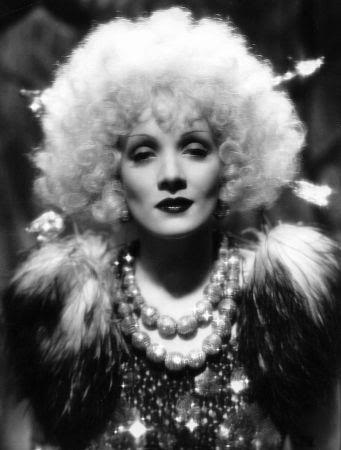
Say, if you like looking at glossy photos of stars from the silent and early sound eras, check out Vintage Images, a new blog with loads of pictures. Three samples:
Marlene Dietrich began her career as a cabaret singer in Berlin and made several silent movies in Germany before rocketing to international stardom in Josef von Sternberg's noirish masterpiece, The Blue Angel. Dietrich's portrayal as the amoral and treacherous Lola Lola set the pattern for femme fatales for decades to come and had American audiences panting to see what all the fuss was about.
Morocco was the second of seven movies (eight if you count the German and English versions of The Blue Angel separately) with director Josef von Sternberg, but the first released in America—Paramount Pictures held back The Blue Angel for a year until it could launch Dietrich's Hollywood career with a more sympathetic role. Morocco proved to be a perfect vehicle for her, fully establishing the Dietrich persona—exotic, jaded, daringly androgynous (for example, she wears a tuxedo and kisses a woman; to quote Robert Osborne, "very European!")—lacking only the humor and self-parody she would later display in films such as Destry Rides Again and Foreign Affair.
Adapted by veteran screenwriter Jules Furthman from the stageplay Amy Jolly, Morocco is the story of a romantic triangle between a cabaret singer, her wealthy patron and a Foreign Legion soldier, who between them have experienced every kind of love but true love, and when at last it happens for each of them, they hardly know what to do with it.
Dietrich is the cabaret singer Amy Jolly (pronounced "Jolie," ala Angelina Jolie), down on her luck and traveling to Morocco for a job. On the boat she meets a wealthy playboy (the always dapper Adolphe Menjou) who as much out of habit as lust dangles jewelry in front of her—as the captain of the boat implies, the stop after Morocco is prostitution and if you're going to go, you might as well go in style—but Dietrich's Amy Jolly is too proud to jump at such baubles. Nevertheless, she turns to Menjou at a critical moment of need.
And all would be well but for the young, handsome soldier (Gary Cooper) sitting in the cheap seats at Dietrich's first performance. Predictably, the two are drawn to each other, at first simply because they are accomplished bed-hoppers who know they will look beautiful in each other's arms, but soon after because they discover in each other a longing for a past they can never reclaim.
"There's a foreign legion of women, too," confesses Amy Jolly, "but we have no uniform, no flag—and no medals." For these two, the single greatest act of passion they can perform is to not perform at all and to the surprise of all involved, genuine intimacy and tenderness develops, not just between the singer and the soldier, as you might expect, but between the singer and her wealthy patron as well.
The result is the warmest of the collaborations between Sternberg and Dietrich, maybe the only film they made together that suggests that the union of a man and a woman can produce something other than misery and obsessive, fetishistic self-destruction.
Morocco was a smash hit, earned four Oscar nominations (for actress, director, cinematography and art direction) and landed Dietrich the most lucrative contract in Hollywood. I should take time to mention the work of cinematographer Lee Garmes whose lighting of Dietrich was a key to the film's success. He positioned the key light above and slightly forward of her which (according to TV Guide's online review) "hollowed her cheeks, shadowed her heavy eyelids, and masked the dimensions of her wide nose." Dietrich was so pleased with the effect, she insisted on it for the rest of her career.
But despite the film's success, the set had not been a happy one. Sternberg focused his attention solely on making Dietrich look good to the annoyance of Gary Cooper, already a big star, and further underscored where his interests lay by speaking only German to Dietrich whenever Cooper was around.
The mutual animosity between director and star had no impact on Cooper's relationship with Dietrich though—shortly after filming commenced, the two began an affair that would continue for years. Despite the fact that she was living with Sternberg at the time, there was no slinking around for Dietrich. Reportedly, she and Cooper conducted their trysts in Sternberg's Hollywood home while Sternberg worked in the garden outside and silently seethed.
I share this anecdote, by the way, not because I am a fan of celebrity gossip but by way of explaining how the partnership of Sternberg and Dietrich, which began with such critical and commercial success, could wind up being a threat to both their careers. More and more, their collaboration became an exercise in voyeuristic excess, with Sternberg trying to control Dietrich with his camera in a way he couldn't control her off screen. And while these films have their champions (see, e.g., Kim Morgan on Blonde Venus or Roger Ebert on The Scarlet Empress), the public gradually turned away until they were turning away in droves.
Dietrich survived the fall by smirking her way through the worst of it—emerging for example from a gorilla costume in Blonde Venus with a half smile that seemed to say I'm so cool even this looks good on me—but Sternberg never recovered, earning only eight screen credits after his last picture with Dietrich (1935's The Devil Is A Woman) and even those credits are misleading, given that he was fired from at least two of those projects, Macao and the execrable Jet Pilot.
In 1939, after years of fading box office appeal, Dietrich reluctantly agreed to star in a comedy/Western, Destry Rides Again. The result was box office gold. Co-starring Jimmy Stewart as a pacifist sheriff armed only with folksy wit, saloon singer Dietrich parodied her own image so successfully she was able to reinvent herself as a comic actress and endear herself to audiences once again. (Madeline Kahn memorably spoofed the performance in Mel Brooks's comedy Blazing Saddles.)
After Destry, Dietrich's best performances were in a pair of Billy Wilder efforts, Foreign Affair, a romantic comedy set in postwar Berlin, and Witness for the Prosecution, a courtroom drama co-starring Charles Laughton, Tyrone Power and Elsa Lanchester. Many will also remember her cameo in Orson Welles's noir thriller, Touch of Evil.
Despite this impressive body of work, Dietrich was nominated for just one Academy Award, for the picture I've just written about, Morocco, losing to Marie Dressler. In 1999, the American Film Institute named her the ninth greatest actress of all time.
After a supporting role in 1961's Judgment at Nuremberg, Dietrich retired from acting, making only one cameo appearance after that, in David Bowie's 1978 misfire, Just A Gigolo. She spent the final decade of her life living in seclusion in her Paris apartment and died in 1992.
Postscript: Be sure to look for a young Cary Grant in the clip from Blonde Venus. This was just his sixth movie and he isn't given much to do—as the New York Times put it in its 1932 review, "Cary Grant is worthy of a much better role." Like Gary Cooper, Grant was the object of Josef von Sternberg's jealousy; unlike Cooper, Grant didn't yet have the clout to do much about it.
Picture:All Quiet On The Western Front (prod. Carl Laemmle, Jr.) Actor: Ronald Colman (Bulldog Drummond) Actress: Louise Brooks (Pandora's Box and Diary Of A Lost Girl) Director: Lewis Milestone (All Quiet On The Western Front) Supporting Actor: Wallace Beery (The Big House) Supporting Actress: Marie Dressler (Anna Christie) Screenplay: George Abbott, Maxwell Anderson and Dell Andrews (All Quiet On The Western Front) Special Awards: Hallelujah! (prod. King Vidor) (Best Picture-Comedy or Musical); Maurice Chevalier (The Love Parade) (Best Actor-Comedy/Musical); Jeanette MacDonald (The Love Parade) (Best Actress-Comedy/Musical); "Swanee Shuffle" (Hallelujah!) and "Falling In Love Again" (The Blue Angel) (Best Song); Arthur Edeson (All Quiet On The Western Front) (Cinematography); Rouben Mamoulian (Applause) and C. Roy Hunter and Lewis Milestone (All Quiet On The Western Front) (Special Achievement In The Use Of Sound) Must-See:All Quiet On The Western Front; The Big House; The Blue Angel; The Cocoanuts; Diary Of A Lost Girl; Hallelujah!; Pandora's Box
"Must see" in this case depends on what you mean by must. If it means "boy, you're absolutely going to want to see it no matter whether you're a casual movie goer or a film fanatic," then we're talking All Quiet On The Western Front and possibly nothing else. It's not just an intense, insightful and historically important movie, it's also one of the most entertaining and watchable movies of the entire era. I've written about it at length here, here and here.
If, on the other hand, by "must see" you mean "what you'll need to see to get a real sense of this moment in movie history and prepare you for what comes next," then I'd say the movies on the above list would do you.
Pandora's Box and Diary Of A Lost Girl show Louise Brooks at her peak. The Big House was Hollywood's first great prison drama, it's packed with action and it features a career-making performance by Wallace Beery. The Blue Angel and The Cocoanuts introduced Marlene Dietrich and the Marx Brothers, respectively, to audiences for the first time. And Hallelujah!, the King Vidor musical starring an all-black cast gives you a chance to see talent, particularly Nina Mae McKinney, that thanks to Hollywood's racism you might never see again.
After that there are a handful of movies I'd give thumbs up to without necessarily calling them essential.
Anna Christie, Bulldog Drummond and The Love Parade I've written about, although in the case of the latter, not extensively. Judging by my readers' reaction to Maurice Chevalier, perhaps that's a good thing.
Our Modern Maidens, which along with Our Dancing Daughters and Our Blushing Brides forms what I'd call Joan Crawford's Flapper Trilogy, is a slight but amusing tale of rich kids in formalwear dancing, drinking and, in general, behaving badly. The only downside is that apparently the trilogy is nearly impossible to come by. None are available on DVD and Our Dancing Daughters, the best of the bunch, is selling for nearly fifty bucks as a VHS tape. I happened to catch all three one weekend on YouTube before they were deleted again, not knowing how lucky I was. If any of them show up again, I'll let you know.
Under The Roofs Of Paris is René Clair's oddball French comedy about a few weeks in the lives of four young Parisians—a street singer, the girl he fancies, her abusive beau and a pickpocket. Clair obviously hadn't quite made up his mind how he felt about the introduction of sound into movies and this is a combination musical, silent pantomime and slap-and-tickle love story that amounts to exactly nothing, like drinking and people-watching in an all-night café. But sometimes drinking and people-watching can be an awfully pleasant way to pass ninety minutes and, if you're like me and that's your idea of a good time, so is Under The Roofs Of Paris.
Raffles is an amusing caper flick starring best actor winner Ronald Colman as a retired safecracker who must elude the police one more time to save a friend from ruin. Raffles's nickname, "The Amateur Cracksman," makes him sound more like the star of a straight-to-video porn movie but it's actually a pretty nifty showcase for Ronald Colman and is readily available on YouTube.
You might also check out The Virginian, Gary Cooper's first talkie (which gave us the oft-misquoted line, "If you're going to call me that, smile!"), and Rouben Mamoulian's Applause, starring Helen Morgan as a stripper who reunites with her convent-raised daughter.
And finally, you may recall that I mentioned Man With The Movie Camera during my two-part discussion of the avant garde movies of the late 1920s. This experiment in film editing by Russian Dziga Vertov is highly regarded by some, including Roger Ebert. Not by me, though.
One problem with following the split-year format the Academy used for the first six years it handed out Oscars is that it obscures the fact that between the release of The Jazz Singer on October 6, 1927, and the premiere of Frankenstein on November 21, 1931, Hollywood only produced one truly great talking picture, and that was All Quiet On The Western Front. Everything else I've written about so far is either silent, foreign or flawed.
The next set of awards won't change things much—1930-31 pretty much shakes out as a three-way slugfest between Charles Chaplin's silent masterpiece City Lights and two foreign-language films, M, Fritz Lang's portrait of a serial killer, and Le Million, René Clair's delightful musical comedy—but at least the stars who eventually gave us the great movies of the Early Sound Era (Cagney, Robinson, Gable, Crawford, Stanwyck, Blondell, etc.) finally make their mark.
Louise Brooks left a comment this morning suggesting she's impatient for my post revealing the best picture of 1929-30, and I am working on it. In the meantime, take a look at some of the performers I considered for nominations before I decided to go in a different direction:
The Marx Brothers ...
... and Margaret Dumont (The Cocoanuts)
Gary Cooper (The Virginian)
Helen Morgan (Applause)
Anita Page (Our Modern Maidens)
Lilyan Tashman (Bulldog Drummond)
Leila Hyams (The Big House)
I encourage you search each of them out (some, I'm sure you have already). They are well worth the effort.


 The Write Stuff Billy Wilder is tied with three other writers for the record for most writing Oscars (three wins, in three different writing categories). For what 1941 comedy starring Gary Cooper and Barbara Stanwyck did Billy Wilder share a nomination with Thomas Monroe for Best Original Story?